
Erosion control strip
as permanent as possible

medium effort
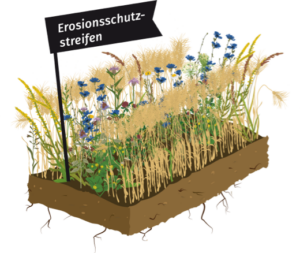
Requirements
Strip width and length
linear, at least 10 m wide
Site and soil conditions:
- dry to wet
- sunny
Seed costs:
approx. 500 - 1,200 €/ha (net) plus tillage
Machinery requirements:
- Cultivator
- rotary tiller
- Drilling machine
- Roller
- Mower
- Grinder or chopper
- Sickle bar mower
Step by Step
implementation instruction
1. Site selection
- on arable land endangered by water erosion
- as transverse to the slope as possible
- along contour lines -> the shorter the slope length, the lower the risk of water erosion
- ganzjährige Zuwegung zum Erosionsschutzstreifen wichtig, damit ggf. notwendige Pflegeschnitte durchgeführt werden können,
- Recommended minimum width: 10-20 m, adapt to individual farm working widths -> the wider the strip, the more effective the measure and the greater the synergy effects for biodiversity conservation
Sowing date
Late summer/autumn sowing:
- from August to mid-September (depending on the weather, by the beginning of October at the latest)
- to be favoured in regions with spring drought
Spring sowing:
- as soon as the weather permits sowing: February/March until the end of April at the latest
- in regions with severe spring drought, if possible until mid-April
Seed selection
- Exclusive use of native, certified wild herbs (VWW-Regiosaaten®, RegioZert®)
- Mixture of at least 20 wild plants, including at least 19 wild herbs and 3-7 wild grasses in small quantities depending on location and utilisation
- Mixture should be adapted to the location: Loess-loam/sand, moist-fresh-dry, example mixture loess/loam dry
Saxony-Anhalt is located in the areas of origin ‘4 - East German lowlands’ and ‘5 - Central German lowlands and hills’. The seed used should originate from these regions.
Further information on the use of regional wild plants (in German)
Seed ordering
- Early planning and ordering, as longer delivery times are possible
- Seed quantity between 8-23 kg/ha (depending on mixture)
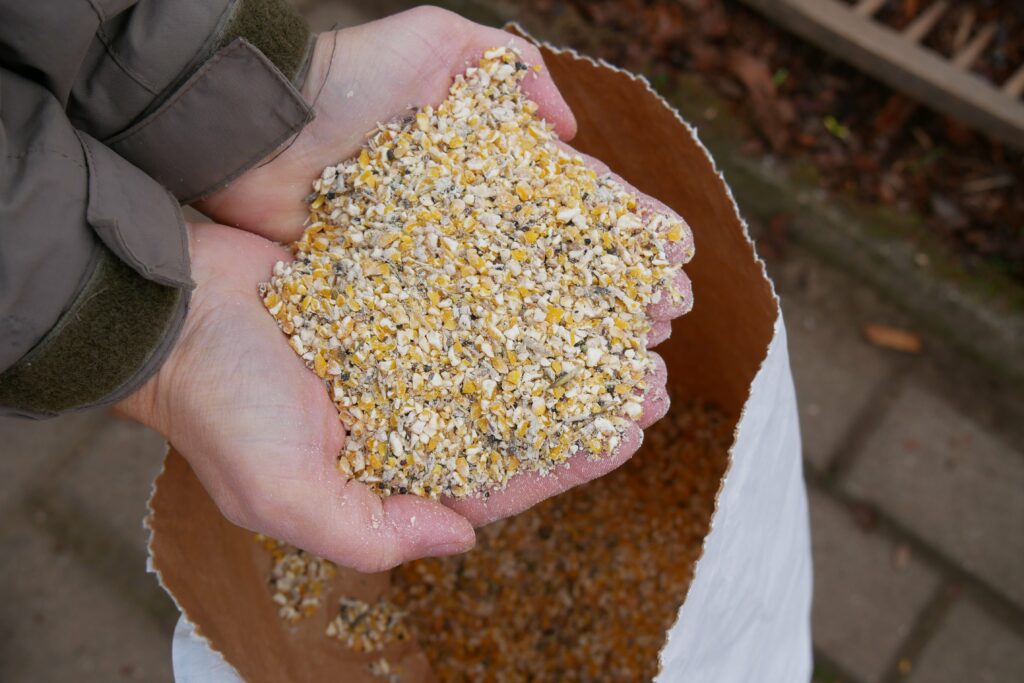
- Mixing with filler (soya meal or crushed maize) to approx. 50 - 100 kg/ha (total application rate, can be ordered ready-mixed from the companies) -> to avoid segregation, for even application
- Seed costs approx. 500 € – 1.200 €/ha
Sources of supply for certified regional wild plant seeds in Germany:
VWW-Regiosaatgut über Verband deutscher Wildsamen- und Wildpflanzenproduzenten e.V.
RegioZert über Bundesverband Deutscher Pflanzenzüchter e. V.
Seedbed preparation
Thorough tillage (stubble cultivation, tilling, cultivating) to produce a fine-crumb seedbed for fine seed sowing (such as arable forage sowing or grassland) must be carried out in preparation.
Sowing
Crucial for successful sowing:
- Sow seeds on the surface (light germinators)
- Do NOT drill in but only ‘trickle on’ -> the light-coloured pieces of the filler must be visible on top of the soil
- Harrow + seed coulters up!
Rolling
Rolling after seeding is important for good contact of the seeds to the soil, which they need to germinate successfully.
Patience! Patience! Patience!
- The germination of wild plants is inconsistent and sometimes very delayed.
- Many wild plants grow more slowly than cultivated species in the first few months and initially look like unwanted weeds.
Give the wild plants time to develop and preferably come back in spring or 3 - 4 months after sowing!
Background information
Wild plant seedlings develop differently to agricultural crops: the germination of wild plants is much more inconsistent and in some cases very delayed. The germination protection of some species must be broken by cold or prolonged moisture. Not all seeds germinate at once, which serves to spread the risk and prevent total failure, e.g. due to drought shortly after germination. Many wild plants grow more slowly in the first few months than cultivated species. Therefore, please be patient after sowing.
Step by Step
maintenance instruction
Development maintenance in the 1st year
The general rule is:
- as little as possible, but as much as necessary
- Care is not mandatory, but is highly recommended in most cases
Carry out a mulch cut (high topping) at a height of approx. 20 cm (to protect the sown young plants). Note: CAN not MUST
When?
- with heavy weed pressure (e.g. dense stands of camomile, broomrape, white goosefoot, amaranth)
- when the plants are about knee-high
- for autumn sowings, possibly still in the same year
Maintenance care from the 2nd year onwards
Maintenance should be at least rotational, either as mowing or mulch cutting.
Mulch cutting
- from the beginning to the middle of July, for wide strips (over 20 m) half of the strip can be mulched (lengthwise) and then either the other half at intervals of 6 to 8 weeks or, on low-yielding sites, annually in rotation.
Mowing
from mid-June, for wide strips (over 20 m) half can be mown (lengthwise) and then either the other half at intervals of 6 to 8 weeks or, on low-yielding sites, on an annual rotation. The mown material can be utilised if required.
Breeding and birthing season
- During the breeding and birthing season from 1 April to 30 June, maintenance pruning should be avoided where possible, unless, for example, a heavy growth of problematic species necessitates pruning.
Maintenance and handling of the mown material
- Maintenance mowing should preferably be carried out on sections of the site in order to preserve areas where species can retreat. Preserving overgrown areas provides food, shelter and egg-laying sites for butterfly species.
- The cuttings can be used or left on the ground as mulch.
- Maintenance can be carried out using a flail mower or mulcher. It is advisable to set the machines to a high height (approx. 20 cm) so as not to damage the young plants.
Ecological impact
Multifunctional, species-rich erosion control strips consisting of wild grass-herb mixtures or pure wild herb mixtures from local, certified seed fulfil many tasks: year-round ground cover, improved soil structure and infiltration capacity of the soil and the creation of urgently needed feeding and breeding grounds and retreats for many species in the cultivated landscape.
Depending on the mixture and the wild plant species used, up to 50 different native insect species can benefit from the measure. The common hornwort (Lotus corniculatus), for example, is used as a food source by at least 36 butterfly species, 13 highly specialised and 44 other wild bee species, the Field Scabious (Knautia arvensis) of up to 44 species of butterflies and at least 16 different species of wild bees, and the Yarrow (Achillea millefolium) of up to 51 species of butterflies and over 20 species of wild bees.
An erosion-reducing field design, such as dividing the slope into sections or changing the direction of cultivation (transverse to the direction of runoff) can also be effective. Likewise, late stubble breaking at the beginning of October or leaving plant residues from previous crops on the soil surface (stubble fallow), coarse seedbed preparation, no harvesting on partial areas, undersowing or the cultivation of flowering catch crops.
Beratungsleitfaden Bodenerosion und Sturzfluten“ (Schriftenreihe der LLG 2018)
Bodenerosionen vermeiden – Biodiversität stärken (Biada et al. 2022)
Video zum Demonstrationsversuch multifunktionaler, artenreicher Erosionsschutzstreifen


