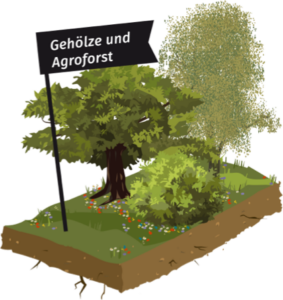
Hedges: €2–10 per shrub, depending on the type and age of the shrub + loss of production area
Field shrubs: €2–10 per shrub, depending on the species and age, plus €0.22 per shrub per watering
Pollarded willows: €5–55 per tree, depending on species and age, plus ongoing maintenance
Fruit trees/individual trees: €45–55 per tree, depending on species and age, plus ongoing maintenance
between €2 and €55 per tree or shrub
Machinery requirements:
variable
Implementation period:
Planting should take place in October/November if possible
Implementation step-by-step instruction
1. Site selection
Suitable locations are:
Areas of open countryside without wooded areas
especially large fields or
small fields that adjoin one another without any woodland or field margins
Edges of paths, ditches or water bodies
Areas at risk from wind and water erosion
Sloping terrain
Selection of planting material
Where possible, site-adapted, native trees and shrubs from regional sources should be used.
e.g. field maple, Norway maple and sycamore, weeping birch, hornbeam, rowan, buckthorn, privet, blackthorn, oaks, dogwood, lime trees, elms, snowball bush, hawthorn, willows, fruit trees such as apple and cherry trees
A selection of native trees and shrubs that are particularly suitable for planting in agricultural areas can be found here: LINK zu Liste aus Anhang X Betriebsplan S. LXXVI
Implementation
Tree and shrub planting can be carried out both as a new development and as a means of enhancing the ecological value of existing structures.
New development
Extensive groups of trees and shrubs: planting in October–November
Linear woodland structures should ideally be flanked on both sides by species-rich margins comprising native wild plants (see the ‘Field margins and edges’ measure)
Enhancing existing woodland structures
Removal of non-native trees and shrubs (e.g. black locust, Canadian poplar)
Replanting of native trees and shrubs
In stands with an ageing tree population, the trees should be replaced gradually. Please note: Trees used as nesting sites by birds of prey will not be removed
General maintenance advice
Maintenance work is permitted from 1 October to 28 February
Maintenance work should generally be carried out in sections
Old and dead wood should be preserved wherever possible
Care must be taken to ensure safety on paths
Various measures:
Planting new hedges
at least 7–10 fruit-bearing tree and shrub species; Note: do not plant hawthorn in fruit-growing areas due to the risk of the plant disease ‘fire blight’
Layout: at least two rows
ideally with a species-rich border on both sides, consisting of native wild herbs
Keep passageways clear in long hedgerows
Care in the first and second years after planting: adequate watering during dry spells
Follow-up care:
Prune back the shoots growing across arable land and paths every 2–3 years
Mow the verges every 2–3 years
It is recommended to prune back in sections in late winter at a height of 20–40 cm approximately every 7–15 years (depending on the location); this helps to prevent the tree from becoming overmature and losing its foliage
Multi-tiered structure: a richly varied combination of shrubs and trees (deep-rooted and shallow-rooted species, light-loving and shade-tolerant species)
Care in the first and second years after planting: adequate watering during dry spells
Follow-up management of field copses/extensive structures: For extensive groups of trees and shrubs: coppice-like follow-up management (gradual development through different age classes)
Planting perches for birds of prey (red kite): e.g. sycamore, small-leaved lime, wild cherry, sweet cherry, common ash, black poplar, aspen, English oak
Care in the first and second years after planting: adequate watering during dry spells
Agroforestry refers to the combination of trees and shrubs with agricultural or horticultural crops and/or the rearing of livestock. The land to be planted retains its status as arable land.
Weiterführende Informationen finden Sie unter folgenden Links:
Hedges, copses, rows of trees and avenues of fruit trees are of great ecological importance. They act as vital links between different habitats; as well as providing protection against erosion, they offer important breeding and feeding habitats for many animal species and enhance the structural diversity and attractiveness of our cultural landscape.
Impact / Promotion of environmental effects / Ecosystem services
Species conservation: beneficial organisms, pollinators, mammals (small mammals, bats), farmland birds and, depending on the measures taken, birds of prey, amphibians, reptiles and wild herbs
Notes
Planting groups of trees and shrubs over a wide area can help to define the boundaries of cultivated areas.
The creation of new linear woody structures, such as hedges with overhanging branches, can help to achieve the objectives of the Saxony-Anhalt Ecological Network (biotope network) and to reduce the size of clear-cut areas, for example by extending existing woody structures.
Supporting small carnivores such as stoats and weasels can help to tackle problems with voles and other rodents