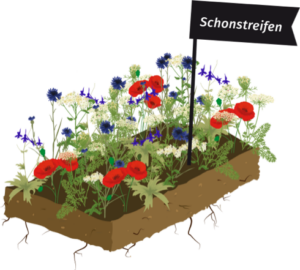
Conservation strips

permanent or temporary

little effort

Requirements

Strip width and length areal - linear:

Minimum width 5 m; annual rotation to other arable land is possible.

Site and soil conditions:

  • dry, mesic or wet
  • Sunny or shady

Costs:

Yield loss

Machinery requirements:

No additional

Implementation period:

at the same time as tilling the field, respect winter dormancy

Implementation
step-by-step instruction

1. Site selection

Suitable are

  • Locations in open fields; along agricultural roads, along bodies of water and on sunny sides of rows of trees, hedges, copses, etc.
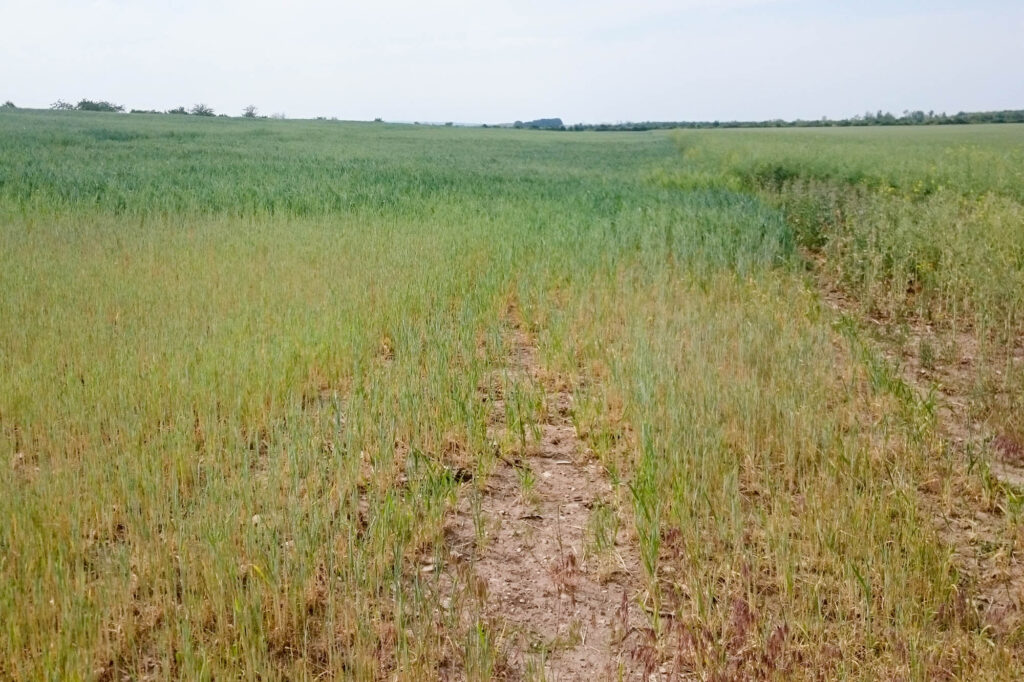
  • especially less productive sites (e.g. very low-yielding and dry areas or heavily waterlogged areas where species such as the lapwing can be promoted)
  • sites with known occurrences of rare arable weeds (e.g. lamb's succory, mouse tail, field larkspur, Large Venus's-looking-glass, field nigella)

Locations with larger occurrences of problem weeds such as couch grass or creeping thistle should be avoided!

strip size at least 5 m wide, up to 20 % of the acreage

  • the wider the strip, the more effective the measure
Low-yield site, Copyright © Foto: J. Knispel

Implementation

  • Conservation strips are not cultivated. There is no sowing (including no crops), no fertilisation and no pest management
  • An annual change to other fields is possible. Tillage is permitted if the field remains in the same location (activation of arable herbs).
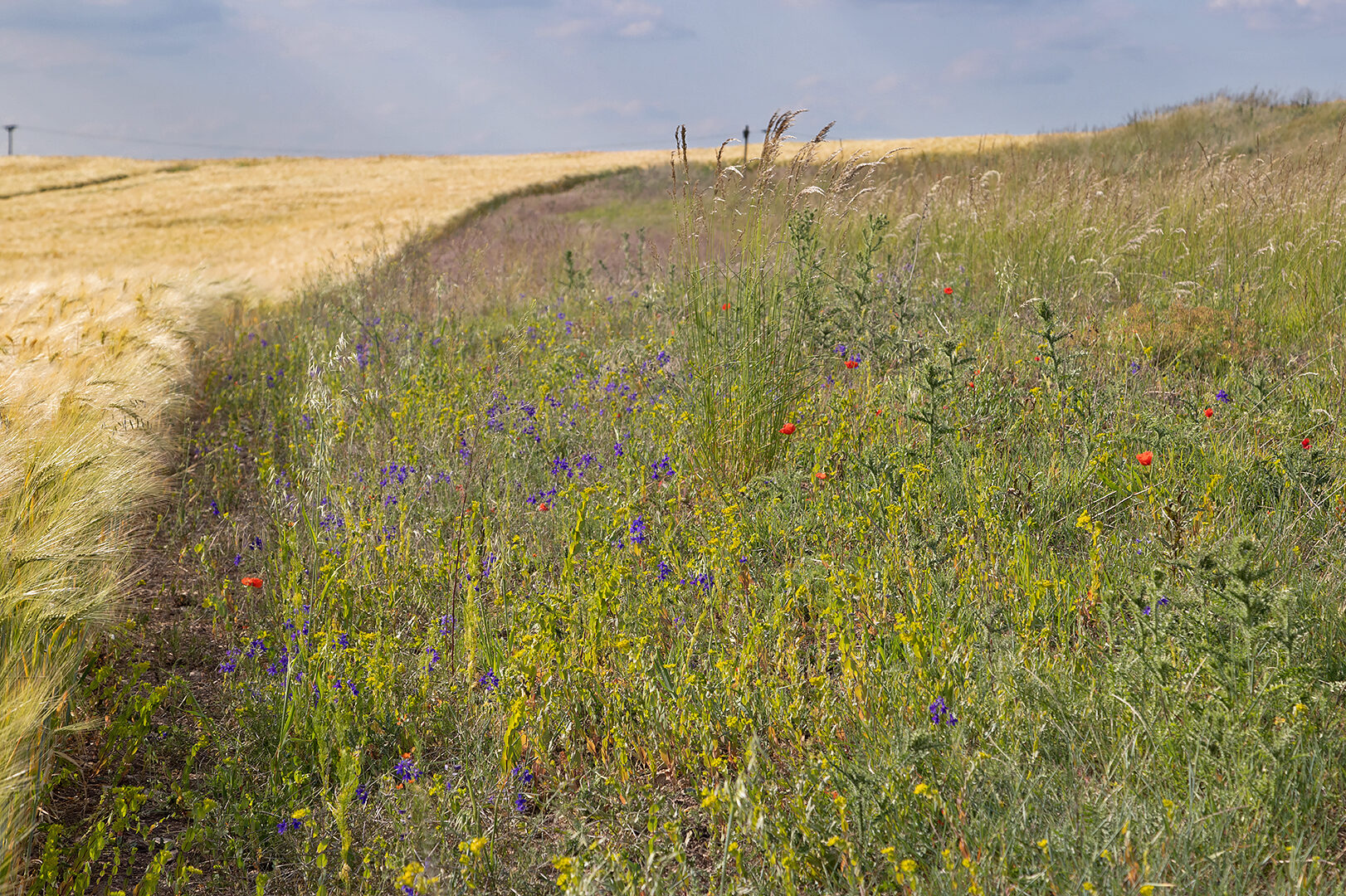
Conservation strip with wild arable plants, Copyright © Photo: S. Mann
Copyright © Foto: S. Mann

Care
step-by-step instruction

Maintenance cutting

If the conservation remains in the same location, selective maintenance cutting may be carried out in sections the following year outside the closed season (1 April to 30 June).

  • Cutting height approx. 20 cm
  • No more than 70 per cent of the relevant conservation strip should be mown at any one time
  • A second maintenance cut after harvesting the remaining arable land is possible

Winterruhe

Auf mind. 30 % des Schonstreifens sollte eine Winterruhe eingehalten werden. Es sollte erst ab dem 15. Februar des Folgejahres umgebrochen werden. Die übrigen Flächen können ab dem 15. Oktober umgebrochen werden.

Ecological impact

Buffer strips are used in particular to promote rare wild field herbs, such as field larkspur, field red campion and field pheasant’s eye, as well as animal species that depend on open areas, such as the skylark and the lapwing. No seeds are sown at all on buffer strips.

conservation strip near Friedrichsschwerz, Copyright © Photo: E. Greiner
A lapwing in a damp field. Copyright © Photo: E. Greiner
English (UK)